

The Intelligence Database
China is not one market.
Neither are its cities.
Understand the differences that matter. Our proprietary intelligence connects demographics, purchasing power, consumer psychology, culture, commerce and local conditions to help you identify where your brand belongs — and how to succeed there.
Better China strategies start with better intelligence.
Our proprietary database maps the commercial, cultural and consumer realities of 134 Chinese cities across five city tiers — giving your strategy a deeper understanding of where your brand fits, why it fits, and how to act.
134
Cities
City-level intelligence across China
5
City tiers
Coverage across urban market levels
19
City clusters
Regional economies and interconnected markets
32
Provinces
Broader regional context for strategy
The Database
One database. Multiple layers of market intelligence.
A city is more than its population and GDP. To understand its potential for a particular brand, you need to understand the people, purchasing behaviours, cultural context, commercial environment and competitive realities behind those numbers. Our database brings these dimensions together in a structured framework designed for market analysis and strategy development.
Strategic question
Is the market large enough, growing enough and economically suitable for this brand?
Strategic question
Does the local population match our target consumer, now and in the future?
Strategic question
What positioning, price point and value proposition are most likely to resonate?
Strategic question
Which consumer groups, business opportunities and market dynamics make this city relevant?
Strategic question
Where and how should the brand reach customers?
Strategic question
Which cultural cues and brand narratives will feel locally relevant?
Strategic question
Which usage occasions, experiences and lifestyle associations can the brand credibly own?
Strategic question
What needs to change in the product, campaign or customer experience?
Strategic question
Is this a market we should enter, and what should we account for before committing resources?
Featured City
One city. Hundreds of strategic signals.
Kunming illustrates how our database moves beyond basic market statistics to build a multidimensional understanding of a city's consumers, commercial environment, culture, economic direction and strategic opportunities.
A Tier 2 city in Yunnan Province, Kunming serves as a regional commercial and transport hub and a gateway towards Southeast and South Asia.
Yunnan Province
Kunming
Population
8.687M
End of 2024 · Metro built-up ~5.6M
Population growth
31.53%
2010–2020 census · 2.78%/yr avg
GDP
¥827.5B
2024 · +4.0% YoY
GDP per capita
¥95,060
2024 · +3.5% YoY
Economic direction
Transitioning towards modern services and emerging industries, including biomedicine, new materials, digital economy and floriculture.
Figures drawn from the current database profile. Reference periods are noted per indicator.
City DNA
Understand the character of a market, not just its size.
The City of Eternal Spring
Kunming's mild climate and outdoor-oriented lifestyle contribute to a strong local identity around quality of life, nature and leisure.
A multicultural urban centre
A long history and a diverse ethnic and cultural landscape, with distinctive regional cuisine, cultural traditions and local identity.
A regional gateway
The city connects Yunnan with other Chinese markets and neighbouring Southeast Asian countries through trade, transport and tourism.
An evolving economy
Traditional industries remain relevant, while modern services, digital commerce, biomedicine, new materials and floriculture contribute to economic development.
Population & Consumer Psychology
Know who you are selling to.
Age distribution
As of 2024
Gender ratio
103.73
Males per 100 females — close to balanced
Migration
High
From Yunnan, Sichuan, Guizhou, SE Asia & students
Consumer characteristics
- • Leisure-oriented and quality-of-life focused
- • Proud of local cultural and ethnic identity, while open to outside influences
- • Pragmatic and value-conscious
- • Increasingly aspirational as education and digital adoption grow
- • Tourism-aware and accustomed to interacting with domestic and international visitors
Spending power
Moderate-to-growing
Price sensitivity
Moderate
Openness to new brands
High
Brand loyalty
Moderate
What this means for strategy
A brand should understand both the city's growing aspirations and its value-conscious consumption patterns. Premium positioning may be viable in appropriate categories, but it should be supported by a credible value proposition and relevant local occasions.
These are structured findings from the city profile, not universal descriptions of every resident.
Economy & Commercial Environment
Understand the ecosystem around the consumer.
Key economic sectors
Industry and commercial data help determine which opportunities are relevant to a specific business — not every sector listed is equally relevant to every consumer brand.
Commercial districts
Nanping Street, Qingnian Road, Kundu Square and growing modern commercial districts. Mid-tier retail maturity with established shopping streets, regional malls and luxury hotels.
Digital adoption
Growing rapidly. Major platforms such as Douyin, Meituan and Didi are established. Digital economy core industry revenue surpassed RMB 100 billion in 2023.
Logistics & trade hub
Kunming serves as a regional logistics and trade hub, with international connectivity and links to Southeast Asia. Top-50 global airport; rail links to Vietnam and Laos.
Culture, Food & Lifestyle
Local context changes how a market behaves.
Granular cultural and lifestyle information can influence product development, positioning, marketing and activation.
Culture
A blend of long-established heritage, ethnic diversity and modern urban development. 54 ethnic groups, 2,400 years of history, and 27 national key cultural relics units.
Lifestyle
Outdoor activities, parks, cafés, flower culture, golf, sports and nature-oriented leisure — enabled by a year-round mild climate.
Food
Yunnan cuisine, crossing-the-bridge rice noodles, steam-pot chicken, wild mushrooms, flower cake and diverse regional culinary traditions.
Shopping
Strong commercial corridors, local specialty shopping, tourism-linked spending and growing online commerce.
Climate
Mild year-round conditions with a distinct wet season from May to October and a drier season from November to April.
Communication
Mandarin is the primary language for broad consumer communications; regional dialect and cultural cues may be relevant for more targeted initiatives.
Insight
The advantage is context. Understanding local lifestyles and cultural associations gives brands a more informed foundation for choosing messages, experiences and occasions that feel relevant.

Kunming's Cultural Identity
Each Chinese city has a unique cultural DNA as distinct as Kunming's.
Isolated by mountains, shaped by migration and trade, and blessed with a mild climate, Kunming developed a cultural identity found nowhere else in China. The depth below — drawn from a single city profile in our database — shows how granular cultural intelligence can inform product, message and occasion.
Founding & Antiquity
Founded in 279 BC during the Chu state's southern expansion, Kunming (historically Yunnan-fu) has been a regional capital for over two millennia. It sits on the ancient Southwestern Silk Road, linking China to Southeast Asia and the Indian subcontinent.
WWII & The Burma Road
Kunming was the wartime terminus of the Burma Road and headquarters of the American Volunteer Group — the Flying Tigers — making it a strategic Allied supply hub and a rare window onto Western influence in inland China.
National Historic City
Designated a National Historic and Cultural City, Kunming preserves 27 national key cultural relic units and 7 national intangible cultural heritage items alongside rapid modern development.
Heritage Meets Modernity
A strong blend of old and new — ancient temples and Qing-era streets sit beside high-rises, luxury hotels and a tech-driven economy, giving the city a layered, lived-in character rather than a museum feel.
Content shown is drawn from a single CityProfile record. Comparable depth exists across all 134 profiled cities, with fields tailored to each city's distinctive characteristics.
Brand Fit & Risks
Turn city intelligence into brand decisions.
Kunming's attractiveness depends on the brand, category, price point and business objective. The database assesses brand fit across dimensions such as premium-market potential, mass-market scale, emerging category opportunities, local lifestyle alignment, cultural relevance, retail and digital accessibility, and market-entry constraints.
Premium fit
A growing middle class, affluent tourism flows, luxury hotels and rising GDP per capita support selected premium categories, although purchasing power remains below leading Tier 1 cities.
Mass-market fit
A large population, everyday retail culture and value-conscious spending support a different proposition focused on accessible value and broad reach.
Emerging categories
Specialty coffee, floriculture-inspired products, functional wellness, outdoor and sports lifestyles, and selected ethnic or cultural lifestyle products may offer relevant avenues for investigation.
The same city can be attractive for one brand and unsuitable for another. The value of our database is its ability to evaluate local conditions against the needs and positioning of a specific business.
Risks and constraints
Identifying constraints helps businesses prioritise investment, select suitable product and pricing strategies, and avoid assumptions based solely on city population or headline GDP.
These are category-level hypotheses supported by the profile, not guarantees of commercial success.
From Data to Decisions
Intelligence is valuable when it changes a decision.
Market selection
"Should we enter this city?"
Population, economic growth, consumer spending power, commercial maturity and brand fit contribute to an initial assessment.
Data dimensions applied
Regional Intelligence
Cities do not exist in isolation.
A strong China strategy needs more than individual city profiles. It must also understand the wider regional systems that shape demand, connectivity, competition and expansion opportunities. Our database includes intelligence for 19 city clusters and 32 provinces, enabling users to connect local market conditions with broader regional patterns.
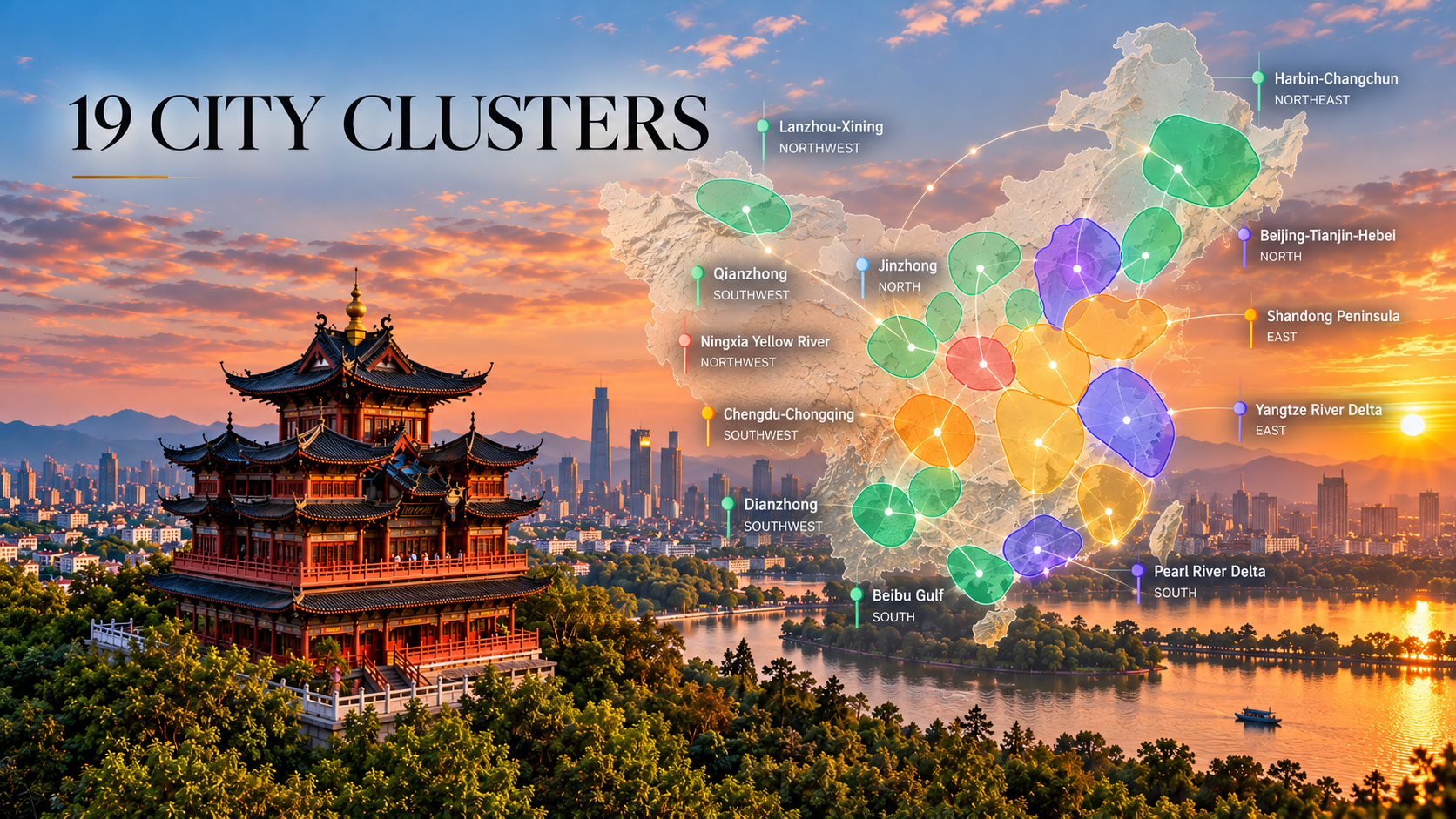
City cluster intelligence
- • Economic integration and commercial relationships
- • Regional consumer and lifestyle patterns
- • Transport and logistics connections
- • Industry concentration and complementary markets
- • Opportunities to coordinate market entry across multiple cities
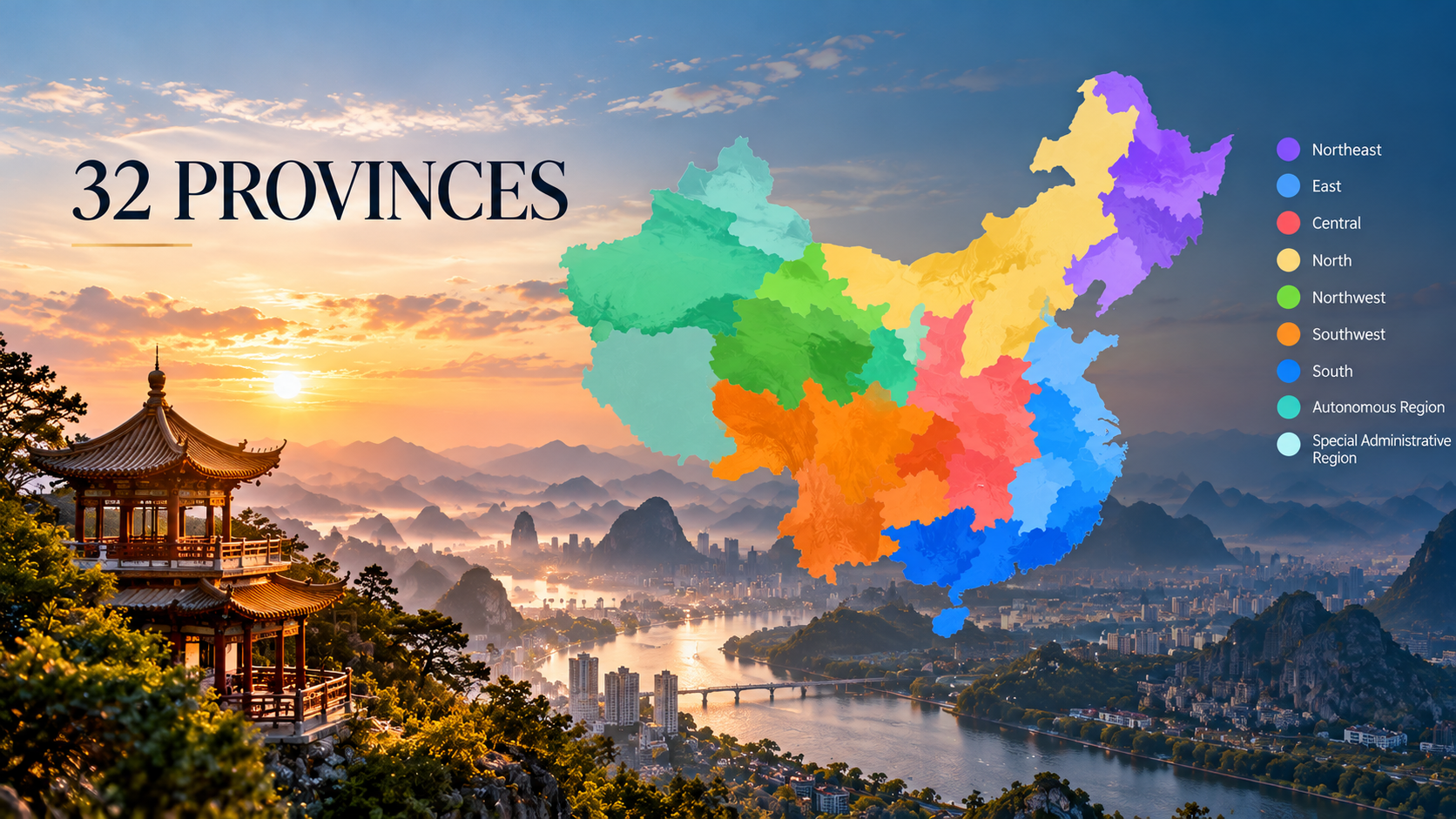
Provincial intelligence
- • Regional economic structure
- • Population and demographic patterns
- • Major industries and development priorities
- • Cultural and geographic differences
- • Provincial policy direction and strategic connectivity
- • Differences between provincial-level context and individual city conditions
Coverage figures reflect the current database. Not every field exists for every province or cluster; profiles are built and maintained as intelligence is gathered.
Our Approach
AI can generate an answer. Better intelligence gives it something reliable to work with.
AI is a useful analytical tool, but generic AI-generated research can be inconsistent, difficult to validate and insufficiently specific to the commercial realities of individual Chinese cities. Our approach starts with a structured, proprietary intelligence base designed specifically for China market strategy.
Generic AI research
- May rely on broad or inconsistent information
- Can produce plausible statements without sufficient supporting evidence
- May overlook differences between individual cities
- Can mix outdated information with more recent developments
- Often requires substantial validation and structuring
- May produce inconsistent comparisons between markets
Our proprietary database
- Structured city intelligence built around a consistent analytical framework
- Multiple dimensions of market context in one place
- Comparable city profiles across five tiers
- Consumer, commercial, cultural, economic and environmental context
- City-cluster and provincial perspectives
- A dedicated foundation for market-fit assessment and strategic recommendations
- A repeatable structure that helps make analyses more consistent and actionable
We don't start with a blank prompt. We start with a purpose-built understanding of China.
Our proprietary intelligence provides the foundation. Analytical tools help interpret it. The result is a more structured way to evaluate markets, understand local differences and build strategies around your brand's actual needs.
Data Quality
Built to be maintained, not generated once.
The database is designed as a structured intelligence asset that can be reviewed and updated as markets change. Each profile carries metadata that reflects its current state.
Profile completeness
98%
Kunming profile — fields populated out of total schema
Last updated
Sep 2026
Most recent profile revision for the featured city
Reference periods
2023–2025
Statistics retain their original reference year
Structured schema
12 dimensions
Consistent framework across every city profile
Where a field is incomplete or requires further validation, the database is designed to flag it transparently rather than fill it with fabricated certainty. Statistics preserve their original reference periods and are not presented as universal truths.

Find the markets that fit your brand. Understand why.
Explore China's cities, compare their opportunities and develop a strategy informed by the realities of the market — not just its headline numbers.
City intelligence. Regional context. Brand-specific strategy.